Zilthum and the Trees
Before we begin to explore Kolgennon as it was left to us by the gods, we should take some time to consider zilthum. That wonderous white-gold ore has been much sought after but little understood in our own age, but I think it speaks both to the knowledge that was lost behind the curtain of Dusk and to men’s tendency to grasp for power, even when it is little understood.
Many claim that it is the crystallisation of divine tears that fell from the heavens, perhaps when Gingel was sacrificed, though the Salxosu claim that it was from the tears that Tholo shed when her son Buto was cast out of Dzottgelon by Dunsun. They assert that it was the crippled god’s fall that shattered the land and caused the great flood that created the middle sea and the White Islands. Then when Tholo wept for her fallen son, those tears landed on the islands and ran into channels that became deep veins of the ore. A claim perhaps given some credence by the ore’s once abundant veins that could be found throughout the islands. At least those of a more sceptical nature could see the truth hidden within the story of the flood.
Certainly, there is something of the immortals about that ore, a divine spark that is hard to explain. It is known to be fantastically resilient and when worked in its purest form can produce the hardest metal, the sturdiest armour and the sharpest blades. But more than that, the ore is said to be a repository of the sorcerer’s craft, able to hold and harness the divine spark in small amounts. The Kinsolsun supposedly were able to fashion items of great power, amulets that were made gifts to the men of old Kolbos for example.

The gods of course could work it into finely crafted tools as Buto did in his forge under the Thelonbet. The Kinsolsun and other beings of a semi-divine nature also showed great skill in working with it in its purest form, the blades that have come down to us, few as they are, are a testament to that ancient knowledge that is now lost to us. It is even said that the smiths of old Kolbos could work the ore, though they could only achieve results with it when mixed with bronze or iron. Though even then, the tales we hear of those smiths’ abilities are incredible. Automotons able to move and act by themselves, great vessels of war, with sails zilthum lined that were able to catch any wind. Alas those skills were lost with the Dusk and now all we can do is desperately cling on to the few workings that have been rediscovered.
Zilthum deposits are also a rarity now. The White Islands took their name from the once abundant mineral, but now it is only by chance that a deposit is discovered even in those lands and if it is then we still lack the skills to work with it, and many miners will refuse to mine the ore anyhow, convinced as they are that some dark magics will be unleashed, has they claim this was how the veil of Dusk was called down.
This does not stop men grasping for power though. Pure zilthum, when it is available, is snatched by the wealthiest of patron, wars have even been started over it. Kunpit long pondered why this was. The ore is useless to us now, we are unable to work it or even discern its rarer properties. So why are fortunes spent, states beggared, and campaigns waged for useless lumps of earth? Kunpit suggested the reason was twofold, a grasp for status and a symbol of control. Zilthum might be beyond us as a practical material, but its status as the ore that was the epitome of a wonderous age remains. Those who possess it can claim to be the inheritors of that legacy and thus derive legitimacy. In that sense, zilthum retains its power. The second reason presented by Kunpit is less tangible but just as illustrative. Namely, zilthum is as close as we can get to the bygone age where once we were greater than we are today. It is a physical link to the knowledge that is beyond our grasp. It is tinged with melancholy and yet we still strive to possess it.

Whilst we paused to consider some of the more intriguing aspects of our world, the sacred trees are both observing.
Tall and slender, with crimson bark and lemon-coloured leaves, the Dolthil tree is sacred across the world. Its fruit sought out by kings and priests to please rulers both mortal and divine. Like so many things in this world, their true origin lays behind the veil of the Dusk.
Multiple stories have come down to us about the origins of these trees. Perhaps the most prominent story among the Xosu, is how the first Dolthil tree sprung up in the environs of what would one day become Thelonigul. Planted by Tholo, who set the great white dragon, Zilthil to protect it. It was only when Xosu himself defeated the dragon, that the tree spread out over the land, helping it to heal and grow once more.
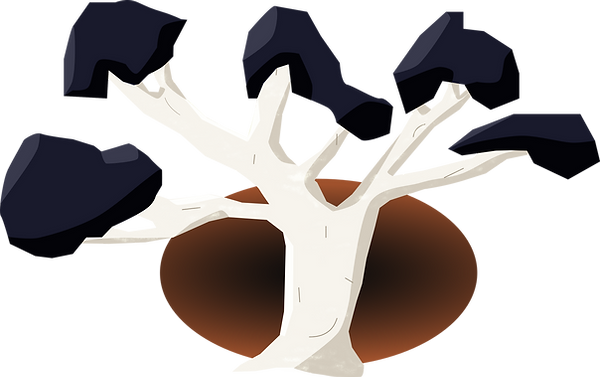
In contrast to the Dolthil tree, the Hulthul tree is squat and thick of trunk, with bone white bark and inky black leaves. However, much like the Dolthil tree, its fruit is also much sought out for the glimpses into the knowledge held by the immortals that it can offer.
Even less is known about the origins of this tree. Some Xosu speak of how their roots reach far down into the hidden realm, and truly they are flora of that domain. The Salxosu however, see them as more sacred than any other tree, a manifestation of the divine power of Buto, the god they favour above all others.